Author: Chris Adams

  • Your Bank Conditioned You to Be a Phishing Victim

    Your Bank Conditioned You to Be a Phishing Victim

    Cybercriminals aren’t after your device. They’re after your identity. And your bank spent thirty years conditioning you to hand it over without a second thought.

    The attack is laughable in its simplicity. A fake Scheels login page. A Microsoft password reset that looks pixel-perfect. A bank notification that mirrors the real thing down to the footer. The fraudster doesn’t need to break anything; they just need you to type your credentials into the wrong box. And here’s what nobody wants to say out loud: this could have been prevented with a few practical security processes. Instead, we built something far more dangerous than any phishing page. We built a culture that conditioned people to hand over the keys without hesitation.

    That conditioning has a name. And it has an origin.

    Identity Is the Currency. Complacency Is the Vulnerability.

    Your username and password aren’t just access codes; they’re a skeleton key to your financial life, your email, your employer’s network. Stolen credentials trade on dark web marketplaces by the millions. A working bank login sells for less than a cup of coffee. Your digital identity has real monetary value to people who will use it with ruthless efficiency.

    And virtually nothing was ever done to make sure you understood that.

    Banks had thirty years of touchpoints to deliver one message. Every login screen. Every fraud alert. Every new card issuance. They had the platform, the trusted relationship, and the captive audience to build one cultural norm:

    Your credentials are sacred. Guard them like cash.

    Instead, they built something else entirely.

    They Didn’t Build a Reflex. They Built a Rescue Line.

    Got phished? The bank refunds it. Card cloned? New one in three days. Account drained? File a dispute, we’ll investigate. The message consumers absorbed, quietly, over decades, wasn’t to be vigilant. It was don’t worry, we’ll fix it.

    This is Cybersecurity Conditioning: the systematic, institutional training of an entire population to treat their digital identity as disposable and recoverable. Banks didn’t invent fraud. But they conditioned the assumption, one refund at a time, that breach is always survivable and always someone else’s problem.

    The fake Scheels site doesn’t succeed because the victim is careless or stupid; it succeeds because that victim has no deeply conditioned reflex that says stop, verify, confirm before you trust. Banks could have built that reflex. It would have cost them friction. It didn’t fit the customer experience roadmap.

    I nearly fell out of my chair when I found out banks don’t even verify signatures on checks anymore. Think about that for a moment. My signature isn’t a formality; it is my legal instrument of consent. It’s what makes the transaction contractually binding. That ritual, centuries old, quietly abandoned for processing efficiency. If the institution holding your money doesn’t believe authentication is worth the effort, why on earth would anyone believe their own credentials deserve protecting?

    It Got a Job. It’s Sitting in Your Office.

    The Cybersecurity Conditioning that banks built didn’t stay at the bank. It got a job; and it’s sitting at a workstation in your office right now.

    Enterprises adopted the same playbook wholesale. Get breached, send a letter six months later, offer ninety days of credit monitoring worth roughly nothing, face no meaningful regulatory consequence, watch the stock recover by Thursday. The signal sent to every business watching was unmistakable; breach is an acceptable cost of doing business.

    Cybersecurity awareness training tried to course-correct. But let’s be honest about what it mostly became; phishing simulations built on urgency and fear, exploiting the same psychological triggers as the actual attackers, hoping annual compliance checkboxes would substitute for genuine culture change. You can’t undo thirty years of conditioning with a click-the-bad-email drill.

    The employee clicking that phishing link isn’t a security failure in isolation. They’re the product of Cybersecurity Conditioning; trained by decades of institutional indifference to treat their identity as something someone else manages.

    Buying Insurance Isn’t a Security Strategy.

    Now businesses have done what businesses do when risk feels unmanageable; they tried to purchase their way out of it. Cybersecurity insurance felt like the logical answer. We’re covered. If something happens, we’re protected.

    Thinking cyber insurance replaces real security hygiene is like thinking you can drive a car without a license. The car doesn’t care. The law does. And so does the insurer.

    Cyber insurance claims are being denied every single day because the business practices required by the policy; the access controls, the documented protocols, the security hygiene; were never actually implemented. Businesses bought the safety net and skipped the safety standards. The insurer is pointing at the fine print. The business owner is holding the bag.

    Sound familiar? It should. It’s the same Cybersecurity Conditioning at work; just with a different institution passing the buck.

    The Buck Can’t Be Passed Forever.

    Banks passed it to consumers. Enterprises passed it to regulators. Businesses passed it to insurers. Somewhere in that chain; usually at the small business owner, the uninsured breach victim, the employee whose identity funded someone else’s recovery; the passing stops.

    A trillion-dollar criminal industry exists not because attackers are uniquely sophisticated. It exists because Cybersecurity Conditioning hollowed out every layer of accountability; institutional, corporate, and personal; until breach became background noise and nobody remembered who started it.

    The conditioning banks built still needs to be undone. That work won’t come from the bank.

    Your credentials are sacred. Guard them like cash. Nobody is coming to clean this up.

  • Should Technology Risk Be Independently Validated the Same Way Financial Risk Is?

    Should Technology Risk Be Independently Validated the Same Way Financial Risk Is?

    During my accounting studies at Boise State University, I learned a principle that has governed serious organizations for decades: financial risk requires independent validation. External auditors exist because boards understand a fundamental truth; the same team cannot implement controls, self-certify them, and claim objective oversight.

    That principle is not controversial in finance.

    What is surprising, after more than twenty years in technology leadership, is how rarely that same discipline is applied to technology risk.

    Today, technology underpins revenue, operations, compliance, and client trust. In performance-driven firms, particularly in financial and professional services, it is no longer a support function. It is revenue infrastructure.

    And when it fails, the impact is not technical. It is financial.

    • A 72-hour outage is not a helpdesk issue → it is revenue disruption.
    • A ransomware incident is not a systems problem → it is a liquidity event.
    • A data breach is not an IT inconvenience → it is regulatory exposure and reputational damage.
    • Weak identity controls are not configuration oversights → they are earnings volatility.

    These are balance sheet consequences.

    Yet many mid-market firms still rely on internal IT teams or managed service providers, the same teams responsible for execution, to define, validate, and report on their own technology risk posture. From a governance standpoint, that structure would never be acceptable in finance.

    The Structural Disconnect

    Internal IT teams are not biased by intent. They are biased by position. Their mandate is execution: uptime, support, vendor management, and project delivery. That focus is exactly what you hired them for. But it also means risk assessment is filtered through an operational lens, not a financial one.

    In finance, CFOs resolve this through third-party compliance and independent validation. The same logic applies to technology, but is rarely applied.

    As firms scale between 150 and 1,000 employees, informal controls and self-validation become fragile. Exposure becomes fragmented. Risk remains unquantified. And without quantification, CFOs face a compounding problem: they know technology risk exists, but they cannot assign dollars to it.

    That gap has real consequences. Without dollarization, there is no budget framework. Without a budget framework, there is no mechanism to offset the exposure on the balance sheet. Technology risk stays in the unpredictable column; which is precisely where CFOs cannot manage it.

    Dashboards are not governance. Monitoring tools are not oversight. Internal reporting is not independent.

    The Necessary Mindset Shift

    Technology risk is financial risk; and like all financial risk, it must move from unpredictable to predictable.

    It affects revenue velocity, margin stability, regulatory posture, insurability, and valuation. The only question is whether it is governed with the same discipline applied to liquidity, credit, and compliance exposure.

    Organizations that make this shift gain structural advantage: reduced earnings volatility, stronger insurance positioning, greater regulatory defensibility, and clearer board-level oversight.

    This is not a technical upgrade. It is a governance decision.

    For CFOs who already understand governance discipline, the conclusion is straightforward: if technology drives enterprise performance, its risk must be independently structured, quantified, and governed, with the same rigor long expected of financial controls.

    If you would like to learn more, please reach out to Rachel HERE to discuss how a professional risk assessment can protect your firm.

  • AI Has a Role in IT — Just Not on the Front Line

    AI Has a Role in IT — Just Not on the Front Line

    Artificial intelligence has a critical role in modern IT — just not on the front line replacing human interaction.

    For decades, the IT industry has steadily removed people from the customer experience in the name of efficiency and cost savings. First came voicemail. Then auto-attendants. Then endless IVR trees. Now AI-powered chatbots and virtual agents are being positioned as the next evolution of “support.”

    The problem?

    When technology fails, efficiency isn’t what users want first — understanding, judgment, and accountability are.

    Organizations don’t struggle because their systems lack automation. They struggle when problems require context, prioritization, and human decision-making — the very things automation cannot replace.

    This is where many IT providers get it wrong.

    AI excels at processing data, correlating signals, accelerating diagnostics, and improving operational workflows. But when placed on the front line of customer support, it often creates friction instead of relief. Users are forced to explain nuanced problems to tools that can’t empathize, escalate judgment calls, or own outcomes. The result is frustration, delay, and erosion of trust.

    At Adams Technology Group (ATG), we believe technology should amplify human intelligence — not replace it.

    That belief is the foundation of ATG’s Human-First Support Platform, a delivery model designed around real people solving real problems, backed by intelligent systems working behind the scenes.

    Our platform is governed by a clear, enforceable standard: 3|29™ — The ATG Performance Standard.

    • Every phone call answered within 3 rings
    • Every ticket responded to within 29 minutes
    • Every issue handled by U.S.-based First Resolution Technicians — not dispatchers

    3|29™ isn’t a target. It’s a standard. It defines how we deliver technology performance for high-performing mid-market financial and professional services organizations that demand reliability, responsiveness, and results.

    Unlike traditional IT providers that rely on tiered support queues, offshore call centers, or dispatcher models, ATG routes every interaction directly to experienced engineers operating at Level II / Level III expertise. These First Resolution Technicians are trained to diagnose, resolve, and own outcomes from the very first contact — eliminating handoffs, reducing escalation, and accelerating resolution.

    Behind the scenes, AI plays a powerful role. It strengthens monitoring, accelerates root-cause analysis, improves ticket intelligence, and equips our technicians with better data faster. But it never replaces the human connection. AI works for our people — not instead of them.

    We don’t use AI to eliminate jobs.
    We use it to make our people more effective, more informed, and more impactful.

    The result is a support experience that feels fundamentally different: faster resolutions, fewer escalations, real accountability, and consistent performance outcomes. This is what high-performance IT looks like when humans are trusted to lead and technology is used responsibly.

    In an industry racing toward automation for automation’s sake, ATG is taking a more disciplined approach.

    AI belongs behind the scenes.
    Humans belong on the front line.
    Performance requires both — in the right places.

    That’s the ATG 3|29™ difference.

  • The IT Bottleneck Collecting Dust — Out of Sight, Out of Mind

    The IT Bottleneck Collecting Dust — Out of Sight, Out of Mind

    Why overlooked infrastructure quietly becomes your most expensive downtime risk

    Out of sight. Out of mind.

    That’s how most organizations treat the small room where their network, power, and connectivity live.

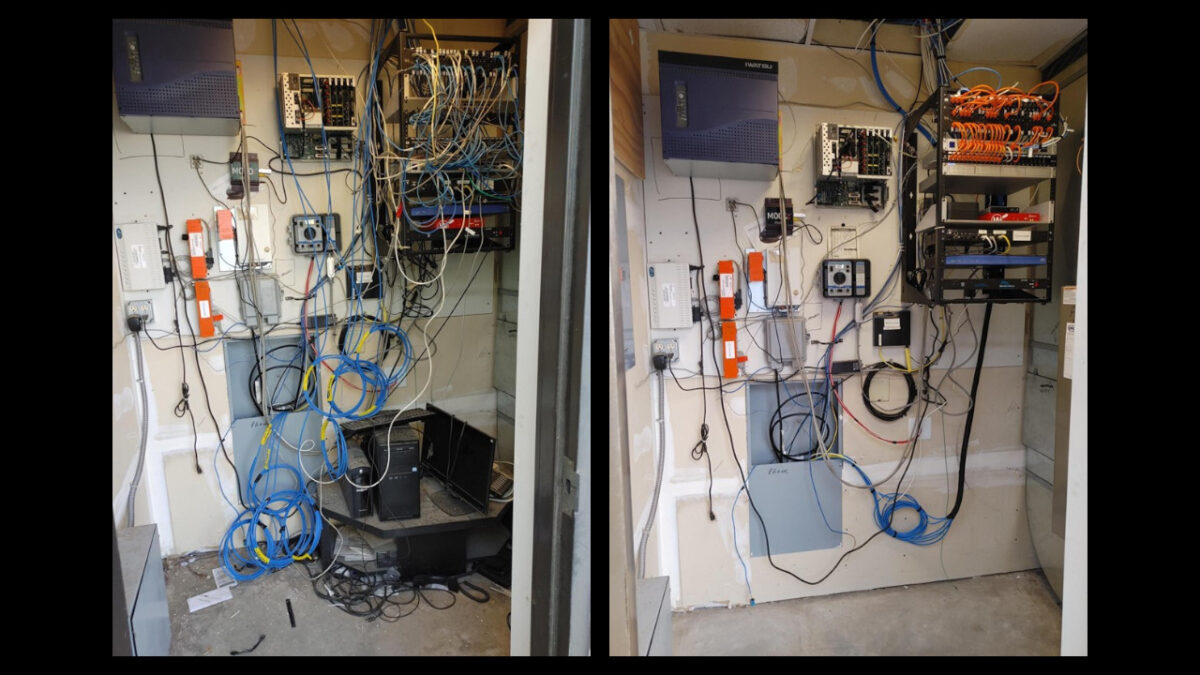
    When CFOs think about technology risk, the focus is usually on applications, cybersecurity, or cloud spend. Rarely does the conversation include a 100-square-foot data or communications room tucked away in a closet, basement, or unused office. And yet, that overlooked space is often the IT bottleneck collecting dust—quietly accumulating risk until downtime makes it impossible to ignore.

    At Adams Technology Group (ATG), we see this pattern repeatedly across mid-market financial and professional services firms: modern software, sophisticated security tools, and cloud platforms running on fragile physical infrastructure. Firms invest heavily in what they can see on dashboards, while the foundation that supports everything else is left unmanaged, undocumented, and undersized.

    That oversight creates IT bottlenecks. And bottlenecks create financial loss.


    Downtime Isn’t an IT Problem. It’s a Financial One.

    Industry research estimates that downtime for mid-market organizations can cost anywhere from $5,000 to $15,000 per hour, depending on revenue, regulatory exposure, and productivity impact. For financial and professional services firms, the true cost is often higher and harder to quantify:

    • Lost billable hours and stalled workflows
    • Missed transactions or delayed closings
    • Erosion of client trust and confidence
    • Compliance, audit, and regulatory risk
    • Emergency IT spend replacing planned investment

    What makes these costs particularly frustrating for CFOs is that many outages don’t stem from advanced cyber threats or complex system failures. They originate from basic infrastructure issues: overheating switches, unmanaged cabling, single points of failure, outdated power protection, or unsecured physical access. 

    All inside the “forgotten room.”


    Why CFOs Overlook the Data Closet

    The data and communications room doesn’t look expensive. It doesn’t generate revenue. It doesn’t show up in financial reports or performance dashboards.

    And that’s precisely the risk.

    When infrastructure is treated as a facilities afterthought instead of a strategic asset, it becomes a silent constraint on performance. Minor issues compound over time. What starts as “just a wiring problem” escalates into hours of downtime, rushed decision-making, and unplanned cost.

    IT bottlenecks don’t announce themselves.
    They accumulate quietly—until they don’t.


    Eliminating Bottlenecks Starts at the Foundation

    At ATG, we modernize and secure critical technology infrastructure to eliminate IT bottlenecks before they impact the business. That work starts at the foundation: the data and communications room.

    A properly designed network environment is:

    • Reliable — Redundant power, cooling, and connectivity reduce outage risk
    • Scalable — Infrastructure grows with the business instead of limiting it
    • Secure — Physical and logical controls reduce operational and compliance exposure

    When infrastructure is intentionally designed, documented, and maintained, downtime decreases, performance stabilizes, and IT spend becomes predictable rather than reactive.

    This is how we eliminate IT bottlenecks.

    Reliable. Scalable. Secure.

    Because the smallest room in your building shouldn’t quietly become your most expensive downtime risk.

  • Why CEOs and CFOs Are Rethinking IT and Security to Protect the P&L

    Why CEOs and CFOs Are Rethinking IT and Security to Protect the P&L

    For years, IT support followed a familiar pattern: something breaks, it gets fixed, and business moves on. That reactive model once worked—but over the last five years, technology has evolved at least tenfold, while many IT teams and service models have failed to evolve with it. Simply repackaging the same reactive approach into a monthly contract and calling it “managed services” hasn’t solved the problem. In many cases, it has only shifted risk away from the IT vendor and left clients paying for bundled services that do little to prevent issues in the first place. The financial impact of that disconnect—between modern technology and outdated IT operations—is now impossible for executive leadership to ignore.

    Today, the conversations I have with CEOs and CFOs aren’t about tools, tickets, or response times. They’re about downtime, lost productivity, and the growing concern that a single failure—whether operational or security‑related—could introduce costs no one planned for. That’s why the move toward truly proactive IT support and managed security isn’t an upgrade. It’s a financial decision rooted in risk reduction, cost control, and predictability.

    Financial Risk #1: Revenue Disruption

    Reactive IT and security models almost guarantee interruption. When systems fail, performance degrades, or threats go undetected, revenue is immediately impacted. Sales stop. Transactions fail. Service commitments are missed. Beyond the immediate loss, leadership is left managing inconsistency that makes forecasting difficult and erodes customer confidence.

    A proactive support model changes that dynamic. Continuous system monitoring, preventative maintenance, and early threat detection reduce the likelihood of disruption before it affects operations. The return is straightforward: stabilized uptime, protected revenue streams, and fewer surprises at quarter‑end.

    Financial Risk #2: Productivity Drain

    When IT support is reactive, the cost shows up across the organization. Internal teams spend their time responding to issues instead of improving systems. Highly skilled, high‑cost employees are pulled into firefighting, while every outage or slowdown costs productive hours across departments.

    Proactive IT support, paired with managed security, shifts that burden. Issues are identified and addressed before they escalate, allowing internal teams and end users to stay focused on their work. The financial benefit is tangible—better use of technical talent, fewer organization‑wide disruptions, and improved operational efficiency.

    Financial Risk #3: Data Loss and Unplanned Exposure

    The most underestimated risk is data loss. Whether caused by a cyber incident or a system failure, the consequences extend far beyond remediation. Regulatory penalties, legal exposure, and reputational damage can introduce long‑term financial consequences that were never budgeted.

    A proactive IT and security model replaces guesswork with structure. Standardized controls, system health monitoring, faster detection, and compliance alignment reduce exposure and help convert unpredictable events into managed, budgeted operating costs. Every organization, regardless of size, needs a clear IT and security baseline—and in my experience, the most effective place to start is with an objective security performance audit that shows exactly where risk and exposure truly exist.

    For executive leadership, the takeaway is clear. IT support and cybersecurity can no longer be treated as reactive or vendor‑centric functions. Organizations that continue to operate that way accept volatility as an unforeseen and unpredictable cost of doing business. Those that invest in proactive IT and security gain predictability, resilience, and measurable returns—the same expectations applied to any strategic investment.

  • Why VPNs are Obsolete

    Why VPNs are Obsolete

    VPNs, Zero Trust, and the Mid-Market: Key Takeaways from Zscaler’s 2025 VPN Risk Report

    As mid-market organizations modernize their infrastructure and embrace hybrid work, one theme keeps coming up: traditional VPNs are turning from a necessary evil into a real liability.

    Zscaler’s ThreatLabz 2025 VPN Risk Report, produced with Cybersecurity Insiders, surveyed more than 600 IT and security professionals to understand how VPNs are impacting security, operations, and user experience in 2025. Zscaler

    Why VPNs Are on the Way Out

    The report highlights several trends that should concern any security-conscious organization:

    • Rising breach exposure via VPN
      Over half of surveyed organizations reported cyber incidents tied to VPN vulnerabilities in the past year. VPN appliances are highly visible on the internet, making them a favored initial access vector for ransomware operators and other threat actors. GlobeNewswire
    • High-severity vulnerabilities are the norm, not the exception
      Analysis of recent VPN CVEs shows a growing share rated high or critical, often enabling remote code execution, privilege escalation, or authentication bypass on exposed VPN gateways.
    • Lateral movement amplifies the blast radius
      Because VPNs drop users “onto the network,” a single compromised credential can allow attackers to move laterally across systems, escalate privileges, and access sensitive data well beyond the original entry point.
    • Third-party and supply-chain risk
      The report notes strong concern about vendor and partner VPN tunnels becoming backdoors into corporate environments—especially when access is broad and poorly segmented.
    • Operational drag and user frustration
      Slow connections, frequent disconnects, and clunky authentication drive user workarounds and generate constant tickets for IT. Maintaining, patching, and scaling VPN concentrators consumes time and budget that could be spent on more strategic security initiatives.

    The Shift to Zero Trust

    In response, organizations are rapidly pivoting away from legacy VPN models toward Zero Trust Network Access (ZTNA) and broader zero trust architectures:

    • 65% of organizations plan to replace VPN services within a year.
    • 81% are adopting or planning to adopt a zero trust strategy on a similar timeline. Zscaler

    Zero trust flips the traditional model: instead of putting users on the network and relying on perimeter controls, it grants only application-level, least-privileged access based on identity, device posture, and context, with continuous verification. This reduces the attack surface, blocks lateral movement, and typically improves performance for remote and hybrid users.

    What This Means for ATG Clients

    For high-performance mid-market organizations, the message is clear:

    • Treat VPNs as a legacy technology to be strategically retired, not expanded.
    • Prioritize identity-centric, zero trust access for both employees and third parties.
    • Use this transition to simplify your security stack, reduce operational overhead, and align access controls with real business risk.

    As your Technology Performance Partner, Adams Technology Group helps clients plan and execute this transition—from VPN-centric architectures to zero trust models that better match today’s threat landscape and performance expectations.

    Learn More about why you should Retire Your VPN.


    Source & Attribution: This summary and commentary are based on the Zscaler ThreatLabz 2025 VPN Risk Report, commissioned by Cybersecurity Insiders and published by Zscaler, Inc.

    Read the full report on Cybersecurity Insiders: Zscaler ThreatLabz 2025 VPN Risk Report Cybersecurity Insiders