
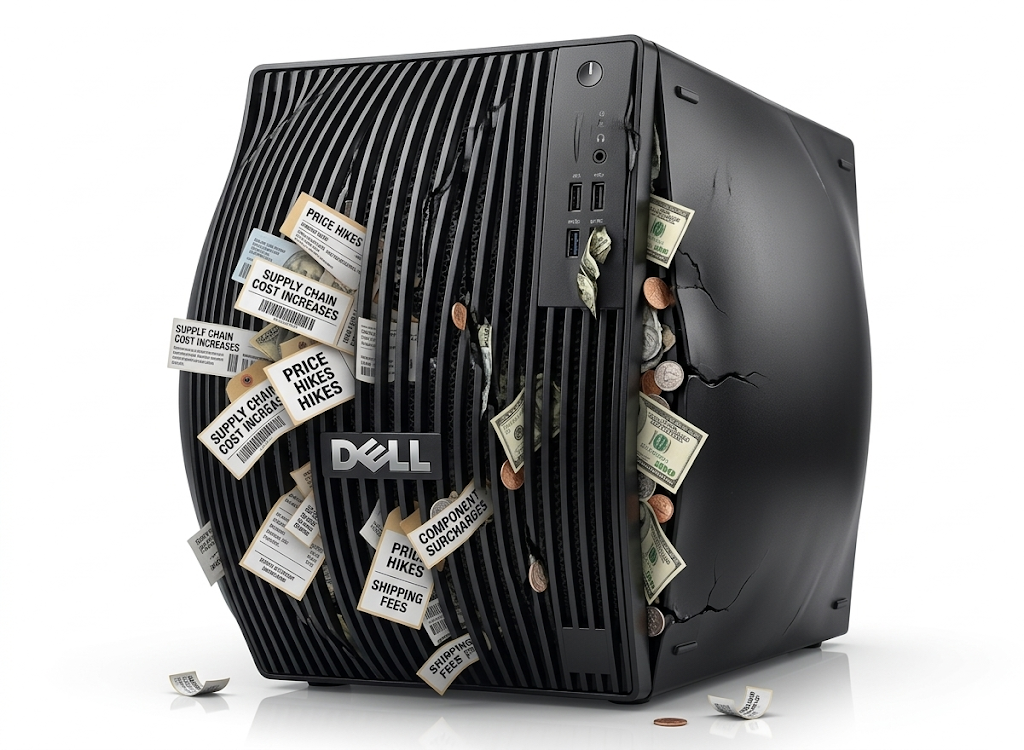
Hardware costs are spiraling. Windows Server 2016 is dying. And the cloud just got a lot more attractive… whether you planned for it or not.
Over the past six months, there has been a change in the market that is dealing a crippling blow to the pockets of everyday organizations. AI is on the rise, and their Data Centers are eating up as much of the market as they can. Processors, DRAM, and SSDs are all affected.
A single 16GB RDIMM DRAM module cost $300 to $400 in November 2025. That same module costs over $2,000 today. That is not a rounding error. That is a 400% surge in one of the most foundational components in modern computing, and it is moving through every server, every workstation and every laptop budget your organization has right now.
Every technology budget your finance team had previously approved needs to be re-evaluated and re-priced. Immediately. What you modeled on six months ago is not what you are buying today.
This is not a supply chain blip. This is a structural hardware cost crisis, and it is arriving at the worst possible moment; just as Windows Server 2016 is closely reaching end of life in January 2027 and firms are forced into a decision they never fully priced into their capital plans.
This Is a Public Service Announcement.
Running unsupported server infrastructure through 2026 and into 2027 is not a neutral choice. It shows up in your cyber insurance questionnaire. It shows up in your compliance audit. It shows up in your exposure surface when something goes wrong, and at that point, the cost of deferral makes the hardware bill look small. The instinct to squeeze another year out of aging servers is understandable. It is also a liability hiding in plain sight.
Every organization sitting at this crossroads needs to hear it plainly: the clock is real, the costs are real, and the budget you planned around no longer reflects the world you are buying in.
For organizations who are dependent on this infrastructure, they are subject to a very costly and critical scenario no CFO ever wants to plan for, failing hardware. We all know the saying “wear and tear”. The older a server gets, the more likely it is to fail. The recommended replacement cycle for a Server is 5 years. At most 7 years. After this, you increase the risk of component failure. After 10 years, that risk becomes expected. By then, organizations are stuck with purchasing new hardware anyways and recovering from backups instead of a smooth and planned migration.
With current lead times on new server orders over 3 months for delivery, and the potential of the order being cancelled, the longer your server is offline, the longer your organization suffers. Cost is only projected to rise, and relief is not expected for at least 2-3 years.
We Have Seen This Before.
The pandemic did something nobody predicted… it collapsed years of cloud adoption hesitation into about eighteen months. When offices closed and infrastructure had to follow people home, the cloud stopped being a future-state strategy and became an operational necessity. Firms that had delayed migration for years moved in months.
This moment rhymes. Hardware cost inflation, end-of-life pressure, and the pull of AI capabilities available natively in platforms like Microsoft 365 and Azure are combining into the same kind of forcing function. At ATG, we are already seeing it; firms that were on the fence about cloud migration are no longer on the fence. The economics made the decision for them.
Microsoft could not have written a better script. Azure absorbs the workloads that no longer make sense to host on-premises. Entra ID and Intune replace the on-premises identity and device management infrastructure. The dependency on owned servers dissolves, and with it, the exposure to hardware pricing cycles that nobody can predict or control. In the short term, Microsoft is going to be a significant winner in all of this. That is not a criticism… it is simply where the market pressure is pointing.
The Decision in Front of You
Firms that treat this as a procurement problem will spend money and still have the same infrastructure risk. Firms that treat it as a strategy decision will come out the other side with a leaner, more defensible, AI-capable operating model.
The hardware crisis is the forcing function. The cloud was already the answer. The math just got a lot harder to argue with. If your organization can work in the cloud, it is time to get started.
Cloud migration isn’t feasible for every organization. Certain software simply isn’t compatible with cloud environments. However, alternatives do exist. It ultimately comes down to how much risk you’re willing to accept.